Showing posts with label Childhood. Show all posts

Wednesday, April 28, 2010

A Lifetime Love Affair (Part I)

Okay. Fair warning dear blog readers. This is a long post. It's so long, in fact, that I'm splitting into three parts. It's essentially about expression of self, but it's also a story that I realized I wanted to give my kids. Partly so they can understand their mom, and partly to encourage them to pay attention to the things in life that feed their souls. So....read on, or tune in next week for a change in topic! ~ mlp

Dear Sarah,

We had a pretty good row this morning about...well,many things I suppose. It was about socially acceptable behavior and who defines what’s right and wrong, it was about judgment of others and ourselves, it was about boundaries and it was about taking a stand for what you believe in. That’s a lot of big stuff to cover in just a few minutes at a fairly heated level of exchange, and I hope we can revisit all of it in a more leisurely peaceful fashion in the near future.

But for now, my darling, I want to talk to you about what started the argument: poetry. I offered you an e e cummings poem to take into English class, where you are currently studying poetry and cummings, and you blanched about taking the poem to your teacher. I then, got more than a little upset with you and the rest is - as they say - history. In fact though, the rest is the story about a lifetime love affair with poetry and how pursuing what you love, will change you forever.

I first declared that I wanted to be a poet “someday” in the fourth grade. A local poet by the name of David Zaslow, came to Lincoln Elementary School to teach us how to "be a poet." His opening reading was the William Carlos Williams’ piece, “This Is Just To Say” 

I have eaten
the plums
that were in
the icebox

and which
you were probably
saving
for breakfast

Forgive me
they were delicious
so sweet
and so cold.

I was mesmerized. David went on to teach us about metaphor and simile, about onomatopoeia and alliteration. He coaxed haiku and small rhyming bits from us, and read aloud from a collection entitled “Reflections on a Gift of Watermelon Pickle” that held 114 treasures about topics ranging from hunting to loneliness, old dogs sunning themselves to biscuits, arithmetic to baseball games. In short, wonderful snippets and stories bound into a few graceful lines - about anything and everything in life. I learned that no topic was off limits, a few key words could speak volumes, and a truly good poem would reach into your gut and momentarily take your breath away.

Mr. Cummings (or shall I say "mister cummings") showed up in my life a couple years later, when I was given a wonderful introduction at about aged twelve by Joe Dubay, a dear family friend. Joe pulled a volume off a shelf in my parent’s house, and asked me if I ever read poetry? I said yes, but confessed that “that guy’s stuff was hard for me to figure out.” Four readings later - together and out loud - and I was hooked. The poem was  “in Just”

in Just-
spring    when the world is mud-
luscious the little
lame balloonman

whistles    far    and wee

and eddieandbill come
running from marble and
piracies and it’s
spring

when the world is puddle-wondeful

the queer
old balloonman whistles
far    and    wee
and bettyandisbel come dancing

from hopscotch and jump-rope and

it’s
spring
and
    the

        goat-footed

balloonman    whistles
far
and
wee

We also had a long discussion about the license that cummings took with his punctuation and suddenly, everything I knew about conventionality and creativity changed. I began to surmise that to be completely daring - one must be comfortable with putting down the manuals and rule books, step off the edge of the writer's cliff and never look back.

At fourteen, with the help of my very hip ninth grade English teacher, Terry Wells,  I fell in love with the lyrics of Paul Simon:

“Time it was and what a time it was,
A time of innocence,
A time of confidences,
Long ago it must be,
I have a photograph,
Preserve your memories,
There all that's left you...”  (from Old Friends)

and declared that despite that fact that Simon was disguised as a musician, he was actually one of the greatest poets I’d ever encountered. And as I merged into the fast lane of adolescence, I began regularly writing my own poems which were, by the way, very very bad. They were full of teen aged angst and sorrow and filled with yearnings for true love and devotion; in a nutshell, they were schlock.

It was in high school that things turned a little sour. For the first time, I encountered teachers teaching poetry who didn’t understand it, didn’t like it and definitely didn’t want to teach it. You see,  Americans, in general, are uncomfortable with poetry. Because of the poetry education that adults once had, or lack thereof, they've been left with the sense that poetry is a subject rather than an art, an experience, or a source of pleasure. However, since I hadn’t drunk the Kool Aid, I was unlike my teachers and classmates who abhorred the required annual poetry unit. My writing continued, and I learned to quietly curb my enthusiasm until my senior year. 

That year, named one of the Oregon’s top young poets through a state contest, I was awarded the honor of spending a full week studying with three very distinguished Northwest writers. More importantly though, I was offered the perspective-changing experience of sharing time with a dozen other kids from around the state who loved writing as much as me. And trust me when I assure you, we weren't a bunch of horn-rimmed, pocket protector geeks. Writers are crazy, imaginative, spontaneous people - at any age, they are passionate about life,  know how to have fun and are fairly fearless when it comes to expressing themselves!

The poet and essayist among those writers, was Kim Stafford (son of poet laureate, the late William Stafford) who further nurtured in me the idea that poems could be found everywhere and in any topic. Whole themes could arise from a single phrase or word overheard on a city bus, read on a billboard or awakening one in the middle of the night. Kim advocated for carrying a notebook to jot ideas, and whether he learned it from his father I don’t know, but like Stafford senior, he was adamant that writing daily was as essential as breathing for a poet. Then, and now, his convictions about writers are strong, “Writers have a place in this essential work -- to question, listen, and tell the connecting stories of human experience, the quiet voices of local life everywhere.”

Soon after, I started university and turned eighteen. If it hadn't happened significantly enough by then, that was the year my dear Sarah, that the work and words of one poet in particular changed my life.

(End of Part I)

Tuesday, April 27, 2010

"A case for tone deaf-two left footed-blocked writers."

When we’re children we all see ourselves as artists.

We see ourselves very clearly as artists until well intentioned and generally loving and chronologically older people socialize us in other directions.

So, when we were kids we actually knew without much question that yes, we were painters, dancers, music makers, storytellers, sculptors, actors and poets. The world was our canvas, and our imaginations and usually very few outside objects were our palates, tools, musical scores and scripts.

We didn’t differentiate being an artist from being ourselves. (By the way, we were also scientists, architects, doctors, athletes, teachers, explorers and any other number of types of “people” we could conceive of in our minds and hearts.)

Somewhere between the state of wonder  and the region of adulthood, our perceptions of ourselves underwent some fairly radical redefinitions. Along with those redefinitions there were heaping doses of judgment mixed in: “This drawing is good.”   “That dance was so-so.” “The song sounds like it needs a little more practice.”  “You’ve got ‘real’ talent.” “Hey look, you got an A” and so forth. It became difficult to continue seeing oneself as much of a creative being when there was always a yardstick being held up by others and eventually, by oneself.

The end result is a rather backward evolution from being thriving artists to being: tone deaf- two left footed- stick figure drawing-blocked writers. Picasso nailed it when he observed, “Every child is an artist, the problem is how to remain an artist once he grows up.”

A giant part of how we grow and learn is tied very tightly with the fundamental need to creatively realize ourselves in the world. It’s vital to give kids opportunities to express themselves in a wide variety of ways and chances to deepen existing relationships with different artistic modes. By giving a child the opportunity for a “WOW” experience in the arts, she might be emboldened to see herself as an artist straight through childhood and into adulthood. He's more likely too, to use that part of his personality to strengthen whatever he has decided to do in the world. 

For those of us who've already crossed into grown up land and have realized that we may have left a crucial part of ourselves behind, we need to remember that not only is it not too late to reclaim our artist-selves - but it may very well be the key to keeping our hearts intact for the long journey of life. It’s as much about choice and attitude as it is actual activity, and it has nothing to do with other people’s assessments. Remember the first line of this post? It’s how you see yourself.

I can look everyone of my close friends in the eye and tell them the ways that I believe they are artists. (Some of them might be a bit shocked!) But who cares what I think, what can you see in yourself?

"Everything we do is art and can be an act of artful living - if we so choose. Writing, drawing, baking, dancing, relationships, work, parenting, even just siting still - especially just sitting still, are all forms of artistry."   m.l.p.

Thursday, April 22, 2010

Careful Out There!


One of my all-time favorite photos courtesy of the very talented Jim Schlight

Did you know that April is “Children and Nature Awareness Month”? I didn’t. In my world, and in my children’s world - every month is Children and Nature Awareness Month. I realize, however; that we are a rare breed of family these days.

As a mother, teacher, artist and poet  I have very strong feelings about Nature and its roll in the lives of children. I strongly hold the opinion and belief that Nature is at the root (no pun intended) of creativity. Nature is grounding, healing, humbling, miraculous, inspiring, frightening, beautiful, vividly honest and a teacher. Nature is an equalizer. I feel that this all applies to ALL of us - of ALL ages.

It wasn’t so many decades ago in our country that when some children were released from school for the day (if they went to school), and they headed home to work on their family farm or, if they were of an age, some other part time afternoon job. If they did neither - they were loose and rambling. In cities, they rambled in and out of doors in a cityscape. In less populated areas, there were woods, fields and beaches to explore.

As anyone who  is paying attention or has kids today knows, the after school and summer vacation-time lives of American children has changed radically - definitely since I was a child forty-odd years ago - but even in the last ten years.  In our relatively small community alone (and granted, this is a fairly affluent community), there are programs galore. There are languages to study, toys beyond belief, waaaaayyy too much electronic stuff, music  (which is wonderful), lessons – lessons – lessons…sports, groups, clubs and so forth. If you look at the calendar hanging in the average Ashland kitchen that tracks the movements of our “average” American children, it truly is incredible. Hopefully, there is gratitude for all of these opportunities, and yet - I’m feeling a bit of melancholy as well.

I’ve a fond childhood memory is of sitting in the apple tree near our family home on Oregon Street. The tree grew in a vacant lot (now there’s a term infrequently used lately), and ones main objective was to get up as high into the branches as possible and eat the tart apples while throwing the wormy ones down the adjacent street. Picture it: the arching, spinning toss of a bright green apple against a pale blue afternoon sky and dangling bare legs and pavement dirty feet hardly visible through the leaves. Hear the laughter and cry of delight at the “Pop!” of the fruit striking the ground; the skin bursts and viridescent flecks go flying, white flesh and seeds explode and scatter across the dark asphalt. Breathe in the too sweet fermenting aroma of windfalls which are composting slowly in the leaves and dirt below, and grin with delight at the mischief and poetry of this simple pastime…sitting in an apple tree.

We have to wonder, in our present busy lives, how many children have spent even ten minutes in an apple tree, much less picked their own tart Granny Smith from a heavy branch? How many backlot spy games will transpire this afternoon? Walks down spring rain dampened dirt paths?  Contests among friends in an open field without a whistle or a score keeper or a clock - where the rules evolve as the sport unfolds and officiating occurs by consensus and fair play?

How many of our children know how to hang out in Nature? How many of YOU know how to hang out in Nature?

It’s really not that complicated and definitely no big deal. You do not have to go camping or hike some steep mountain. Just step outside a few extra yards today. Leave your agenda (and your iphone) behind. Whether the place in nature is a window box, a back yard, an apple tree or the deep woods – when Nature and humans are brought together peacefully – there is positive alchemy that feeds imagination, curiosity, intelligence, relationship with self - and thereby others, and one’s very soul.

Careful out there. If you do it everyday, in some small way, even for just a moment or two - you will change. For the better.

To explore the very real phenomenon of Nature Deficit Disorder, check out the incredible work of Richard Louv, author of Last Child In The Woods.

To read up on how other communities are pursuing No Child Left Inside, start here with a fantastic article from Orion magazine.

To change your mind and your heart, the only link to click is the off button on this box. Try it for a bit, and take a walk in your neighborhood.

Tuesday, March 30, 2010

Extending Life's Radius


 Mt. Shasta - a mere 76 miles from home - taken from Hwy 89 vantage

I heard somewhere that it’s not unusual for “most” people in the world to be born, live and die within a twenty mile radius. This is easy to imagine, when I consider the lives of folks living in developing countries, but it’s damn near impossible to fathom when I look through the rose-colored lenses of my middle class American educated upbringing in comfortable Ashland, Oregon. Nevertheless, the girls and I pondered this “leaving one’s known twenty mile turf” theory while our odometer logged in more and more miles in the opposite direction of home. We were readily able to acknowledge that our act of packing up and making a 1500 mile trip would be considered a very large departure of the norm for many folks.

Perhaps that was part of the reason our trip was such a stretch for me; I was actively choosing to drive away from a safety net I have had anchored in place since I was about ten years old. See, I was the kid who wouldn’t accept a sleepover invitation unless it was close enough to home that I could easily walk home (or be picked up by a sleepy parent ) at 12:30 A.M. That was about the hour I would invariably realize that I was SO wickedly homesick, so painfully anxiety-ridden with fear of being away - that,  with knees literally knocking together, I'd make the walk of shame to the parent’s of whichever friend had invited me over and ask permission to call home.

Mind you, after playing out that particular scenario two or three times in elementary school, it ceased to continue with regularity because I became a skilled practitioner of avoidance and was adept at politely refusing most invitations to slumber parties, Friday night sleepovers and summer weekend camp outs. In middle school, when the social ladder is as much a part of one’s overnight luggage as a comfy pillow, it was often a very tough call between accepting an invitation (and perhaps spending a night in overwrought tension) or declining (and being left out of essential adolescent  exploits to be shared among peers on Monday morning by the lockers). Sometimes I would momentarily forget my angst - in the excitement and thrall of potential adventures, and I would say “yes” to a generous friend who wanted my company. Then, I would remember my looming apprehensions at the last moment and crumble in complete humiliation - disappointing tenfold whomever my pal was with a phone call to say, “Sorry; I can’t make it after all.”

By the time I was fourteen, my parents were ready to disown me due to what they considered irrational behavior. It wasn’t irrational to me though, nor was it complicated. I didn’t particularly need THEM to be at home; in fact, they could travel away all they wanted, as long as they left me there  - safe and snug. About the time that they began to surrender to the idea that I would live in Ashland forever and never trot the globe, I began to conquer some of said homesickness by the company I kept, and made my first successful trip away with my high school sweetheart and his parents at fifteen, and the rest is - as they say - history. Sort of.

Diagnosis-wise, I’m fairly certain my symptoms were anxiety attacks, not exactly your run-of-the-mill childhood homesickness, but truly scary events. Do I still experience that knee-shaking, belly quaking fear from time to time? I guess the fact that I have traveled happily and successfully for the past three decades is some sort of “Proof of Ability,” but the honest answer is: Yes. Absolutely. (And I’ve learned to get over it.)

The first two nights spent with my son in the oncology unit at Oregon Health Science University gripped me like I’ve never been gripped, and since Reid’s cancer diagnosis, I have become reacquainted with fearful feelings I haven’t felt since adolescence.

So this first trip out and away since leukemia moved into our family, this first time away from Reid since he got sick, THIS was a big departure from the “new norm” of our life. All the way to Death Valley, California I asked myself, “Is fear of FEAR big enough to hold me back anymore? Do I decline otherwise new journeys because I’m afraid of being sick to my stomach with terror in the middle of the night? After having come all this way - after having left behind all that we once believed was comfortable and familiar, is worry big enough to keep us from venturing out, kids in tow to see, share and discover this amazing planet?”

I know it will be a damned tough call at times. Sometimes, like this past week, I will have to dig very, very deeply into my heart, remind myself to breathe and resolutely plant one foot forward. Being able to set forth and journey - both literally and figuratively - was and is a privilege and a joyful act of life celebration. The learning opportunities outside our doorsteps have as much to do with what we experience while away - as how they impact our return and the changed, hopefully sweeter relationship we will bring back home. 

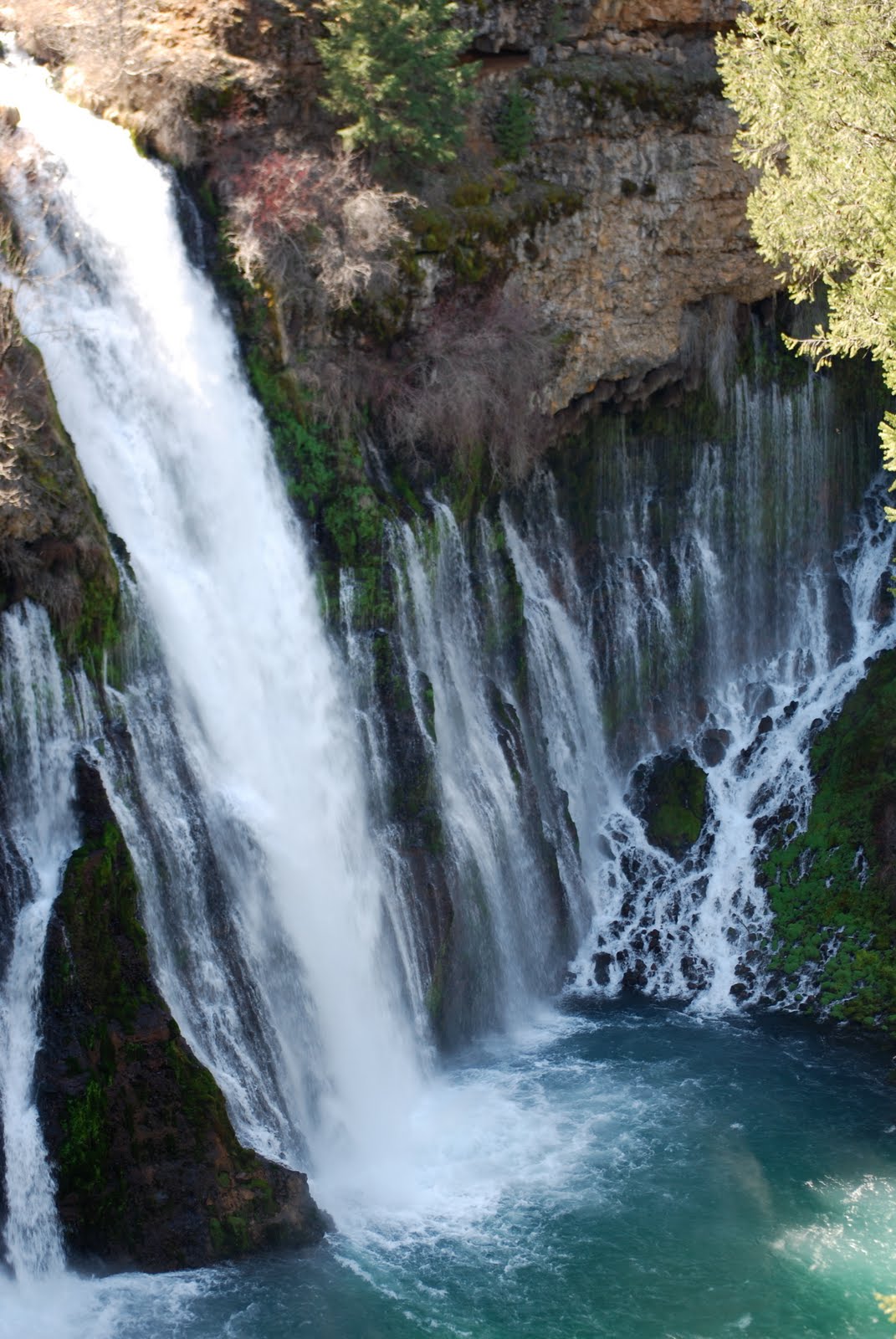
 McArthur-Burney Falls Memorial State Park, CA
127 miles from Ashland, OR

Wednesday, March 3, 2010

Sick Days

I have a kid home sick today, so I'll keep this brief.
Assuming that most of my readers are over thirty, do you remember sick days as a kid?
I do. In a word - they were, besides bearing all the trademarks of typical childhood illness's (low grade fevers, puking, sore throats and horrid head colds), BORING.
In my family of origin, staying home sick from school meant sleeping, reading, pretending the lines of the quilt were roads, drawing pictures and occasionally, if one had an exceptionally bad headache, and if one of my parents had stayed home to adhere to those lines in the unwritten contract of parenting (Section II, article IV: "When your kid runs a fever over 101.5, you are required to take a day off of work.") - then we might get read out loud to for 20 minutes. By the time I had done all of those things, I only had another six and a half hours of feeling lousy and bored until one of my siblings came home from school. By the time I was a teenager, the sick day repertoire expanded to listening to records or sometimes being allowed to bring the 18 ton "portable" black and white tv into my bedroom to choose between three channels of daytime television.
The beauty of sick days back then were that they were so horrendously mind-numbing, the motivation to get well soon was very very high. Anything at school (except for the cafeteria food) was better than being stuck at home with a snotty nose.
Here at my house, in this grand new year of 2010, being physically ill is no less of a drag, but the stay at home perks are abundant. First off, I work at home - so Mama is on call all the time. Since 7:30 this morning, I have delivered tea, pancakes, re-warmed the tea, whipped up an egg and toast, administered children's ibuprofen and opened a fresh tissue box. The many voices of Jim Dale (brilliant reader of all the Harry Potter audio books) is drifting down the staircase into my office, and I know that when I go to check on my rosy-checked girl, she'll be contentedly snuggled down in the blankets in a Hogwarts induced stupor.
She's already asked for the laptop and Netflix, to which I replied with a firm negatory. An order for the next in a series of books she is reading will hopefully be filled at the public library. An art pad awaits when she feels ready to sit up, and the kitchen won't close all day long. She'll be amused, but not too; we'll both be grateful that I work at home, but I'll surrender much of the day (in accordance with section II article IV). She’ll whine a bit, sigh a few hundred times, and her healthy little body will race through this with nary an issue. All will be well.

 
My gal on a feeling great day, not so long ago!

Monday, March 1, 2010

Marching Forth!

March first, march forward, march your self, soul and heart into the arms of joy in the moment! I invite you to witness such a moment in time (just last week) with my favorite ten year old. March into gladness and click this link: Swing! 

(You may want to make yourself a cup of tea while it downloads, it seems to take a minute or two. Sorry, this is one of the techie issues of Blogger. Nevertheless, it's a 1 min. slide show that's worth the wait!)


I believe in all that has never yet been spoken.
I want to free what waits within me
so that what no one has dared to wish for
 
may for once spring clear
without my contriving.
 
If this is arrogant, God, forgive me,
but this is what I need to say.
May what I do flow from me like a river,
no forcing and no holding back,
the way it is with children.
 
Then in these swelling and ebbing currents,
these deepening tides moving out, returning,
I will sing to you as no one ever has,
 
streaming through widening channels
into the open sea.
 
 
~ Rainer Maria Rilke ~

Friday, February 26, 2010

The Soul Of My Boots

I held my first “real” job during the summer of 1978 in Jackson County, Oregon working for the Youth Conservation Corps which at that time was managed through our local Bureau of Land Management office.Definition of “real” to me at fifteen years old included the following characteristics: an application and interview, a dress code, a commute to work, an absolute starting time and a regular quitting time, Monday-Friday, rain or shine and a proper paycheck (though  minimum wage at that time was $2.65 an hour - so however proper it might have been, is arguable).

In a nutshell, YCC is  a National Parks Service program employing youth between 15 and 18 years old to do everything from clear invasive species, to build and repair trails, to upkeep park’s facilities like playgrounds and picnic areas, to piling and burning slash, to helping demolish old buildings. That particular summer, our main project was building the Sterling Creek trail outside of historic Jacksonville (picture scrub oak and madrone, and very dry soil conditions in the traditional 100+ degree July weather of Southern Oregon). I used tools with names like pulaski, mattock, McLeod, grub hoe, council tool and the ever popular pick axe. Almost all of them involved swinging with a fair degree of momentum and upper arm and shoulder strength, and yes - I was pretty continuously sore that entire summer.

Everyday at 5 am I would drag my grumpy teenaged butt out of bed, make a behemoth sack lunch, fill my canteen, dress in the required gear (long denim pants, long sleeved denim shirt bearing the proud green and white YCC patch, over the ankle leather boots, 3/4 length leather work gloves and a bright yellow hard hat) and walk down to the corner convenience store to be picked up by one of our crew leaders with whom I commuted from Ashland into Medford. We’d arrive at the Medford armory by 6:30 to get our daily assignments and be loaded into pale green BLM vans and on our way by 7 AM. We’d be returned eight hours later - filthy, stinking, red faced, dehydrated, famished and $21.20 richer.

Let me get one thing very clear here. I was not a soft girlie girl at fifteen. I was an athlete, a tom boy of the highest order, a wizened treehouse builder and explorer of all things dirty, muddy and imbedded in poison oak, a seasoned weed puller and gardening assistant to my parents and an avid camper. If anyone could make it in YCC, it was me. Right. After two weeks I was completely ready to throw in the towel - or trowel - or whatever. I had never worked so physically hard in my entire life. Never. Never. Never. And never mind that the 5 am thing was killing me, too! Had it not been for my boyfriend Joe’s dad, I surely would have quit. But he sat me down one evening while I was whining about the work and gave me the most wonderful and positively delivered version of the “Once a quitter always a quitter” speech that I could have ever asked for. He helped me change my mind, and I then became my own agent in changing my life.

Had I quit, in the ensuing eight weeks I would have missed out on learning to build a cross buck fence (a part of which still stands around one end of Hyatt Lake, and I can look at with pride even after 32 years). I would have missed the day we were rewarded by a trip to Crater Lake and the exhilaration I felt while running off the dock at Wizard Island and flying into the icy cold, crystal clear, aqua-colored ancient waters. I would have missed standing with my cohorts by the Sterling Creek sign that declared it was build by the YCC. I would have missed being tapped by a supervisor to spend an entire day in the field with a wildlife biologist doing bird counts and especially, tracking down and locating endangered owls in the Cascade Mountains. I would have missed the comedy of peeling off my jeans each afternoon with my gloves still on so I wouldn’t get poison oak from my britches - and the look of respect that my father gave me as I would tell him about my day. I would have missed discovering an essential part of myself - that self that doesn't just work until it’s hard, but works past the point of “hard” to “accomplished.”

Any what, pray-tell, does any of this have to do with Boot Week in the studio? Well, I was thinking last night about boots I have worn and the life I have experienced while decked out in this particular form of footwear. I kept trying to figure out, which pair of my boots do I “love” the most (aka - which life experience in boots has left an indelible mark?), when I realized - the pair I love the most are the boots I wore that long hot dust-covered summer working for YCC. When it was over, I couldn’t part with them, you see. First of all, after three months of wickedly hard wear and tear, I had worn them to a slipper comfort-like cured quality, and anyone who has ever tried to break in boots will tell you, that’s a beautiful thing for one’s feet. But mostly, they stayed with me as worn leather trophies of a job well done and my literal symbols of the proverb  “walk my talk.”

Two years ago, my elder daughter found them in a box and asked if she could wear them for hiking and service work at school. I took them out, rubbed the cracks smooth with beeswax, and passed them over to her with pride.


Monday, January 18, 2010

Everything Essential


We were strolling along in downtown Seattle, going 
no where in particular.

It strikes me as so poignant 
that we're looking in opposite directions.

I remember, feeling restless -
(and quietly disappointed) that day.
I had expected something else
(I don't know what, precisely), but not what showed up.

Meanwhile, He was content.
 With hands sticky from a yogurt snack
and a day that was warm and bright,

his intense and perfect face gazes 
across the street where 
life "on that side"
was so intriguing that in fact,  yes

yes, in fact
  he was tugging (just a bit) - as if to say,
 "Hey Mama, let's go look over there!"

Funny...
what stands out in one's memory after sixteen years:

small damp fingers,
deep restless sighs,
the sound of shoes on dry cement,
the need - no matter how separate our immediate desires -
 to stay connected to each other,

and the belief that holding hands
would keep everything essential intact.


 Reid and Martha - Seattle, Washington 1992 - Photo taken by Dan Rankin

Tuesday, January 12, 2010

"Oh My God...How Risky."

The wind and rain did some serious window rattling last night. My youngest - despite her own awareness of the mountains rising protectively around our hometown - asked as she was surrendering to sleep, "Are you sure we can't have a hurricane here?" It was a concern I remember having myself as a child in this very same town, and I cherished the sensation that we lived in such a remarkably safe place.


Ashland, Oregon is a sweet-natured, semi-conservative, attractive to big city refugees, feels-slightly-metropolitan but is actually a fairly-small-town -- that is tucked into the foothills of the Siskiyou and Cascade mountains. It's not geographically conducive to tornadoes or tsunami's and it's been a long time since the last volcanic eruption. I happily settled here, in part, to give my own kids the same nurturing and sheltered childhood that I experienced.

While social and economic times and ways of the world have grown and shifted, Ashland, Oregon has been fortunate to keep crime and calamity to a minimum. But it's not a utopia, so occasionally bad things happen to this good community. Most recently, a couple incidence of sexual assult. The response throughout Ashland has been swift and vocal. Newspaper articles, police warnings, a composite sketch, internet messages with safety tips, announcements at the University and local high school, and even a "Take Back the Night" march to raise awareness. It's good stuff. When alone it's smart to tune in; be familiar with one's surroundings; take off your ipod and listen to the world around you; practice "wide angle vision" (a tracking term for seeing and intuitive awareness  much further than the distance between self and screen, steering wheel or Wii);  walk with a "don't mess with me" confidence. They don't always stop the worst, but employing these tools and others will definitely increase one's odds of well being.

So, here am I, finishing today's blog so that I can -- go for a walk, in broad daylight, in the rain, ALONE! Oh my god...how risky. 

Let's face it, we can spend our whole lives being afraid or cautious - or even equal and intelligent parts of both. We can employ every measure of safe living and behavior that we are taught. We can stay in, lock the doors, filter the water, "green" the house, eat organic, take our vitamins, put on our coat, walk with a buddy and carry pepper spray, but in the end, we have no control.  Huh? Nope. Nadda.
Sometimes, no matter what you've done "right," a monster shows up. Shit happens -- in spades -- right in your own living room. 

Having recently lost so much of the freedom I treasure so dearly and the sense of safety -- for myself and my loved ones -- that I have always prized, I will not relinquish a simple act that brings me joy. I will take walks.